



Jump to: Houston Metro & Suburbs | Dark Sky Parks & Regional Spots
Houston’s city lights can make spotting stars a challenge, but you don’t have to travel far to find a better view of the night sky. The best spots for stargazing near Houston range from lakeside viewing areas and local observatories to remote Texas parks where the Milky Way shines overhead.
Bring binoculars, book a telescope session, or plan an overnight camping trip to catch the stars after dark.
Editor’s Note: We work hard to provide you with accurate, updated information. However, all details may change. Please verify information before heading out. This post may contain affiliate links.
If you click and make a purchase, we may earn a small commission at no extra cost to you. We only recommend experiences we truly believe in!
Curious about how we choose our content? Here’s our process.
Also, check out our articles on Best Parks in Houston, Best Greenways & Bike Trails in Houston, and Best Fall Road Trips and Weekend Getaways from Houston.
Top Spots for Stargazing near Houston
George Observatory (Brazos Bend State Park)
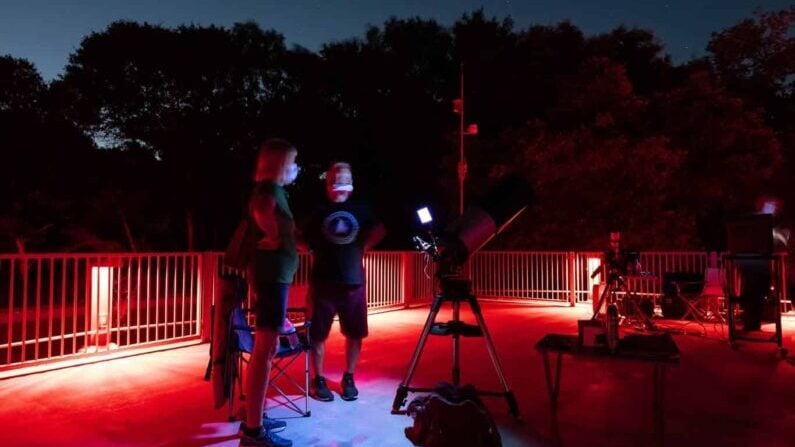
Image credit: Houston Museum of Natural Science
Get a close-up look at Saturn’s rings, distant star clusters, and the Andromeda Galaxy through the 36-inch Gueymard Research Telescope at George Observatory, about 45 miles from downtown Houston.
The telescope’s enormous aperture helps bring out details you’d struggle to see with smaller equipment, making this a memorable stop for your stargazing near Houston plans, even under the area’s moderately light-polluted skies.
Saturday nights bring together amateur astronomers from the Fort Bend Astronomy Club, who set up their own telescopes alongside the observatory’s three domes, and HMNS staff astronomers who can help you make sense of what you’re seeing.
You can ask questions, compare views through different instruments, and get a better feel for the night sky without needing a telescope of your own.
For the clearest views, look toward the southern and western skies, which have less interference from Houston’s urban glow.
When: Saturdays, 9 – 11 pm
Where: George Observatory, 21901 FM 762 Rd, Needville, TX 77461
How Much: $13 per person
Brazos Bend State Park
Bring a telescope or binoculars to Brazos Bend State Park and settle in beside 40-Acre Lake or Elm Lake, where open shorelines give you room to scan the southern and western skies.
You won’t get the Milky Way’s full sweep here under the park’s Bortle 5 skies, but planets, bright star clusters, and the Moon still offer plenty for you to see. It’s one of the most accessible stargazing spots near Houston, no deep countryside drive required.
You can also stay overnight to have more time to watch the sky darken, too. Campers can continue observing until 11 p.m., an hour later than day visitors can remain in the park.
When: Daily, 8 pm – 10 pm
Where: Brazos Bend State Park, 21901 Farm to Market Rd 762, Needville, TX 77461
How Much: $7 | Free for kids 12 and under
Sam Houston National Forest
Sam Houston National Forest, about an hour north of the city, is one of the more underrated stargazing spots near Houston for those willing to find the right clearing.
The forest canopy blocks some of the surrounding light pollution, but it can also hide the stars you came to see.
Head to the Stubblefield Recreation Area and Cagle Recreation Area near Lake Conroe. These spots offer more open views over the water, giving you room to scan the sky without branches getting in the way.
Clearings around the lake are estimated to have Bortle 4 to 4.5 skies, darker than those at Brazos Bend State Park. That means more stars to pick out with the naked eye and a better chance of spotting brighter deep-sky objects through binoculars.
Bring your own gear, choose a spot with a clear view, and give your eyes time to adjust to the darkness.
When: Monday – Friday, 8 am – 11:30 am and 12 pm – 4:30 pm | Camping recommended for stargazing
Where: Sam Houston National Forest, 394 FM 1375 West, New Waverly, TX 77358
How Much: Free
SHSU Dominey Observatory
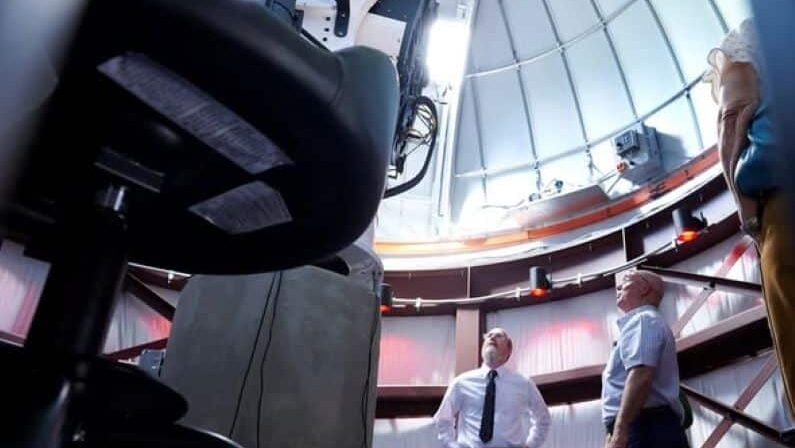
Image credit: Sam Houston State University
A 27-inch research-grade telescope, free public viewing nights, and a rural setting about an hour north of Houston make SHSU Dominey Observatory a worthwhile destination for curious skywatchers.
Located off Highway 19, the observatory houses a PlaneWave CDK700 capable of revealing galaxies, globular clusters, and planetary details that are difficult to pick out with smaller telescopes.
The observatory also uses a custom periscope attachment that brings the eyepiece down to a comfortable seated height, making viewing accessible to wheelchair users.
Its rural location offers roughly Bortle 4 skies, giving the telescope darker conditions than you’ll find closer to the city. Sessions take place on Saturday evenings twice a month.
You can also join the SHSU Physics Department mailing list to hear about upcoming dates. Just take note: public sessions are limited to 30 people, so you’ll need to plan ahead rather than show up and hope for a spot.
When: Public viewings are often on Saturdays around 8 pm
Where: Sam Houston State University, 1905 University Ave, Huntsville, TX 77340
How Much: Free
Houston Astronomical Society Dark Site
For a stargazing trip that goes beyond a quick look through a telescope, head about 80 miles west of Houston to the Houston Astronomical Society’s dark site near Columbus, known to members as Padhenge.
The facility has 38 concrete observing pads arranged in a circle, with electrical hookups within 50 feet of each pad for telescope tracking equipment.
There’s also a sliding-roof observatory with three permanently mounted telescopes, including a Celestron C14, plus loaner scopes, restrooms, showers, camping areas, and bunkhouse rooms.
On clear, moonless nights, the site has recorded sky brightness readings of 21.34 to 21.42 SQM, consistent with the society’s Bortle 3 classification. That means you have a much better chance of seeing the Milky Way’s structure, tracking down faint galaxies, and spending hours on deep-sky observing without the city’s glow washing out the view.
Annual membership starts at $36 and includes 24/7 access after a short online orientation. If you plan to make stargazing near Houston a regular habit, this is the most capable dark sky facility within two hours of the city.
When: Open 24/7
Where: Exact address is only released to members
How Much: Regular Membership: $36
Dark Sky Parks Texas & Regional Astronomy Spots
Enchanted Rock State Natural Area
Climb Enchanted Rock’s 425-foot pink granite dome and you’ll have a wide-open view of the Texas Hill Country sky, with no trees or ridgelines blocking the horizon.
The park holds a Gold Tier International Dark Sky Park designation, and its skies can reach readings above 21.5 mag/arcsec² on a sky quality meter. That means it’s dark enough that you can see impressive details on the Milky Way with the naked eye.
The surrounding towns help protect those views, too. Fredericksburg, about 18 miles south, has its own Dark Sky Community designation. And the nearby towns of Llano and Mason have adopted outdoor lighting ordinances that help reduce the glow around the park.
For the darkest views, aim west or south, away from the stronger glow toward Austin and San Antonio.
Enchanted Rock also hosts Rock Star Parties throughout the year in partnership with the Hill Country Astronomers. Rangers lead guided sessions, and you can bring your own telescope to explore the sky at your own pace.
When: Daily, 6:30 am – 10 pm
Where: Enchanted Rock State Natural Area, 16710 Ranch Rd 965, Fredericksburg, TX 78624
How Much: $8 for adults | Free for kids 12 and under
Copper Breaks State Park
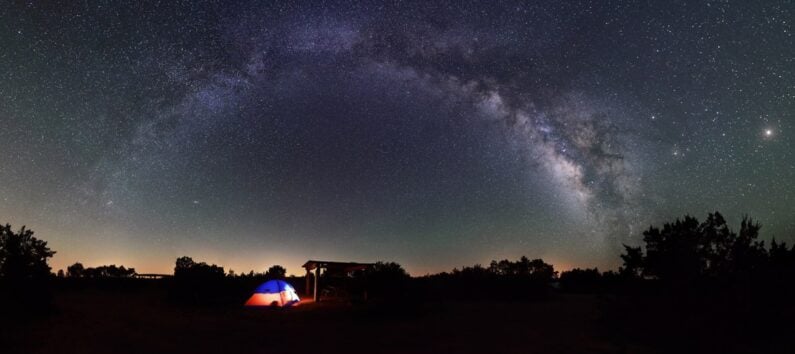
Image credit: tpwd.texas.gov
Copper Breaks State Park sits in the wide-open Rolling Plains of North Texas, about 13 miles south of Quanah and roughly 60 miles from Wichita Falls.
With Bortle 2 skies and an unobstructed horizon, it’s an excellent place to watch stars and planets rise without hills or buildings getting in the way. The park even has a dedicated Dark Sky Viewing Area near the Equestrian Trailhead, and its lighting fixtures are designed to limit light pollution.
On a clear night, the Milky Way can appear as a richly textured band overhead, while constellations such as Sagittarius, Scorpius, and Orion offer plenty to pick out with the naked eye.
Monthly Star Walk programs also run from April through November, with park rangers guiding visitors through the night sky at no extra charge beyond park admission.
Copper Breaks was among the first two Texas state parks to receive International Dark Sky Park designation in 2014, making it a well-established destination for anyone exploring dark sky parks in Texas.
When: Daily, 7 am – 10 pm
Where: Copper Breaks State Park, 777 State Hwy Park Rd 62, Quanah, TX 79252
How Much: $3 for adults | Free for kids 12 and under
Lost Maples State Natural Area
Lost Maples State Natural Area pairs dark Hill Country skies with the rugged scenery of Sabinal Canyon, near Vanderpool.
Its Bortle 3 conditions make it a strong choice for seeing the Milky Way. A permanent sky quality meter even provides real-time readings through the Putman Mountain Observatory monitoring network.
The canyon walls do limit the horizon in some places, particularly to the north and south, so choosing your viewing spot carefully makes a difference. Primitive campsites on higher ground can offer a more open view than spots down on the canyon floor.
The San Antonio Astronomical Association and the San Antonio League of Sidewalk Astronomers also host star parties that give you a chance to observe alongside local astronomy enthusiasts. You can even bring your own telescopes.
Photographers will also be thrilled by the sight. The Milky Way’s bright core can make a striking subject above the canyon and cedar-covered slopes, particularly in summer.
When: Daily, 8:30 am – 4:30 pm
Where: Lost Maples State Natural Area, 37221 RM 187, Vanderpool, TX 78885
How Much: $6 for adults | Free for kids 12 and under
Big Bend National Park
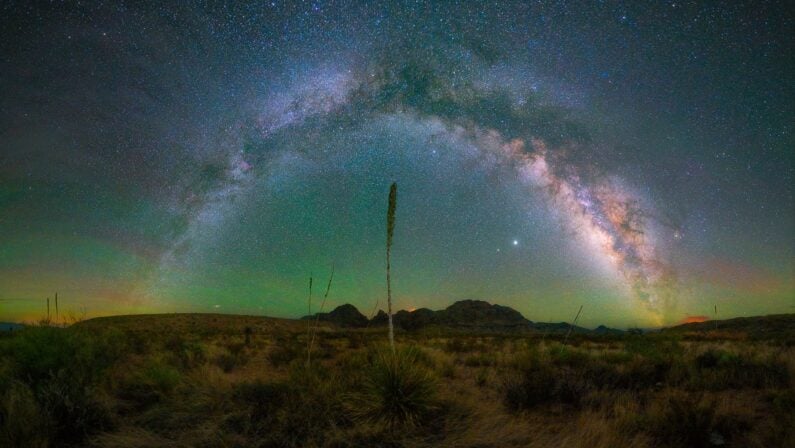
Image credit: Big Bend National Park
Big Bend National Park is worth the long drive for one major reason: its night skies are among the darkest in the contiguous United States.
In the park’s darkest areas, Bortle 1 conditions reveal details that are difficult to see anywhere near a major city. The Milky Way can cast a faint shadow on the ground, while the zodiacal light and gegenschein become visible under exceptionally dark conditions.
Big Bend also sits within the Greater Big Bend International Dark Sky Reserve, a protected region spanning more than 15,000 square miles across Texas and Mexico.
The park’s desert basins and roads along the Rio Grande offer broad views of the sky, while the Chisos Mountains provide higher elevations and a different perspective on the surrounding landscape.
National Park Service rangers also run night sky programs throughout the year, including guided night hikes, telescope sessions, and astronomy talks. Check the weekly Ranger Program Schedule before your visit to see what’s planned during your stay.
When: Daily, 24/7
Where: Big Bend National Park, Texas, United States
How Much: $30 per private vehicle | $15 per person
McDonald Observatory
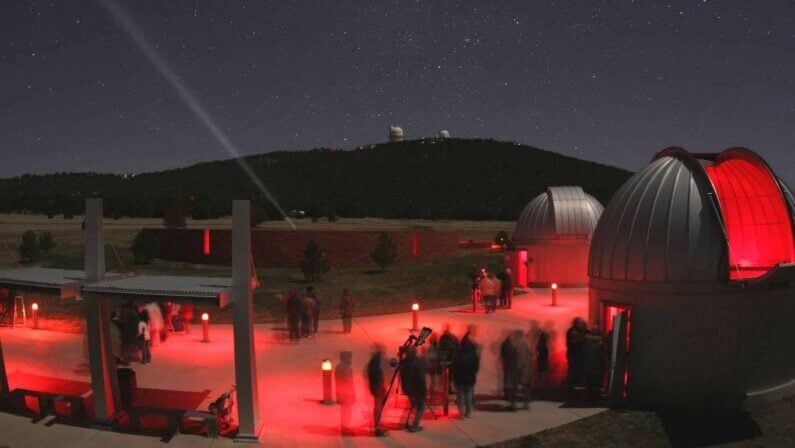
Image credit: McDonald Observatory
At 6,791 feet on Mount Locke in the Davis Mountains, McDonald Observatory gives you access to dark West Texas skies and public telescope viewing at a working astronomical research facility.
Clear skies are common here, and the observatory’s Star Parties at the Frank N. Bash Visitors Center let you explore the night sky with help from staff astronomers.
The evening typically begins with a constellation tour before you move to the outdoor telescope viewing area, where instruments include a 16-inch Ritchey-Chrétien and a 22-inch Cassegrain, along with additional telescopes operated by volunteers.
You can also book a Special Viewing Night for a closer look through larger research instruments. Options include a 36-inch telescope for small groups and the 82-inch Otto Struve Telescope, one of the major attractions for visitors interested in observing through a much larger instrument.
Just take note, Star Parties can draw more than 1,000 guests in a single evening, so reserve tickets well ahead of your trip.
When: Tuesday – Saturday, 12 pm – 5 pm
Where: University of Texas McDonald Observatory, 3640 Dark Sky Dr, Fort Davis, TX 79734
How Much: Varies by event | Please check the website for ticket prices for your chosen event
Know Before You Go: Local Stargazing Tips
Most of the best stargazing spots near Houston sit outside the city, but several are within a 45-to-90-minute drive of Katy, The Woodlands, Sugar Land, Pearland, and Conroe.
Before you pack your telescope or head out for the evening, check a few things to give yourself the best chance of clear skies.
- Check the Moon Phase: A New Moon offers the darkest skies, making it easier to spot faint stars and deep-sky objects. A thin crescent moon can also work well, especially if you want to see the Moon itself.
- Bring a Red Flashlight: White light can interfere with your night vision, making faint stars harder to see. Use a red LED flashlight to find your way around without losing your view of the sky.
- Check the Weather: Clouds and humidity can affect visibility, so check the forecast before making the drive. Apps such as Clear Outside and Astrospheric can help you check cloud cover and observing conditions.
Common Questions about Stargazing near Houston
Why can’t you see the stars in Houston, Texas?
Houston’s city lights create skyglow, which makes faint stars and distant celestial objects harder to see, particularly in densely developed areas.
You can still spot bright stars and planets in the city, but you’ll have a much better view of the night sky at locations farther from urban lighting, such as Brazos Bend State Park or observatories outside the metropolitan area.
Where is the best stargazing in Texas?
Big Bend National Park and McDonald Observatory in West Texas offer exceptionally dark skies, while Enchanted Rock State Natural Area and Copper Breaks State Park are excellent choices for stargazing in designated International Dark Sky Parks.
If you’re starting from Houston, George Observatory at Brazos Bend State Park is a more convenient option for public telescope viewing without a long drive across the state.
When can I see the Milky Way in Texas?
The Milky Way’s bright central region is generally visible on clear nights from spring through early autumn, with summer offering some of the best opportunities.
For the clearest view, choose a dark location away from city lights and plan your visit around a New Moon or a night when the Moon sets early. The exact viewing window depends on the time of year, so check a stargazing calendar before heading out.
Where can I look at the stars near Houston?
George Observatory at Brazos Bend State Park is one of the most convenient choices for guided stargazing near Houston. On Saturday nights, you can view celestial objects through large telescopes, meet amateur astronomers from the Fort Bend Astronomy Club, and get help identifying what you’re seeing.
If you’d rather bring your own binoculars or telescope, the surrounding state park also offers places to observe the night sky.
Looking for more? See the upcoming Weekend Events in Houston.

- Best Astronomy Parks & Stargazing Near Houston - October 15, 2026
- Fun, Free & Cheap Events | October 16 – October 18 - October 12, 2026
- Houston Highlights: October 12 to October 15 – Food, Music, Arts & More - October 11, 2026


